Polynomial generalised eigenvalue decomposition (PGEVD), non-stationary broadband sources and polynomial-matrix demixing
My research on polynomial generalised eigenvalue decomposition (PGEVD) extends the conventional generalised eigenvalue approach from instantaneous, narrowband mixtures to polynomial matrices representing convolutive broadband systems. The central application considered here is blind source separation (BSS), where the objective is to recover unknown source signals from observed mixtures without prior knowledge of the mixing system.
In broadband problems the mixing process cannot in general be represented by a single scalar or instantaneous matrix. Propagation, reverberation and multipath effects introduce delays, so each source-to-sensor path is more naturally represented by a finite impulse response filter. Collecting these filters gives a polynomial mixing matrix. Polynomial-matrix decompositions therefore provide a natural framework for extending familiar narrowband matrix techniques to convolutive multichannel signal processing.
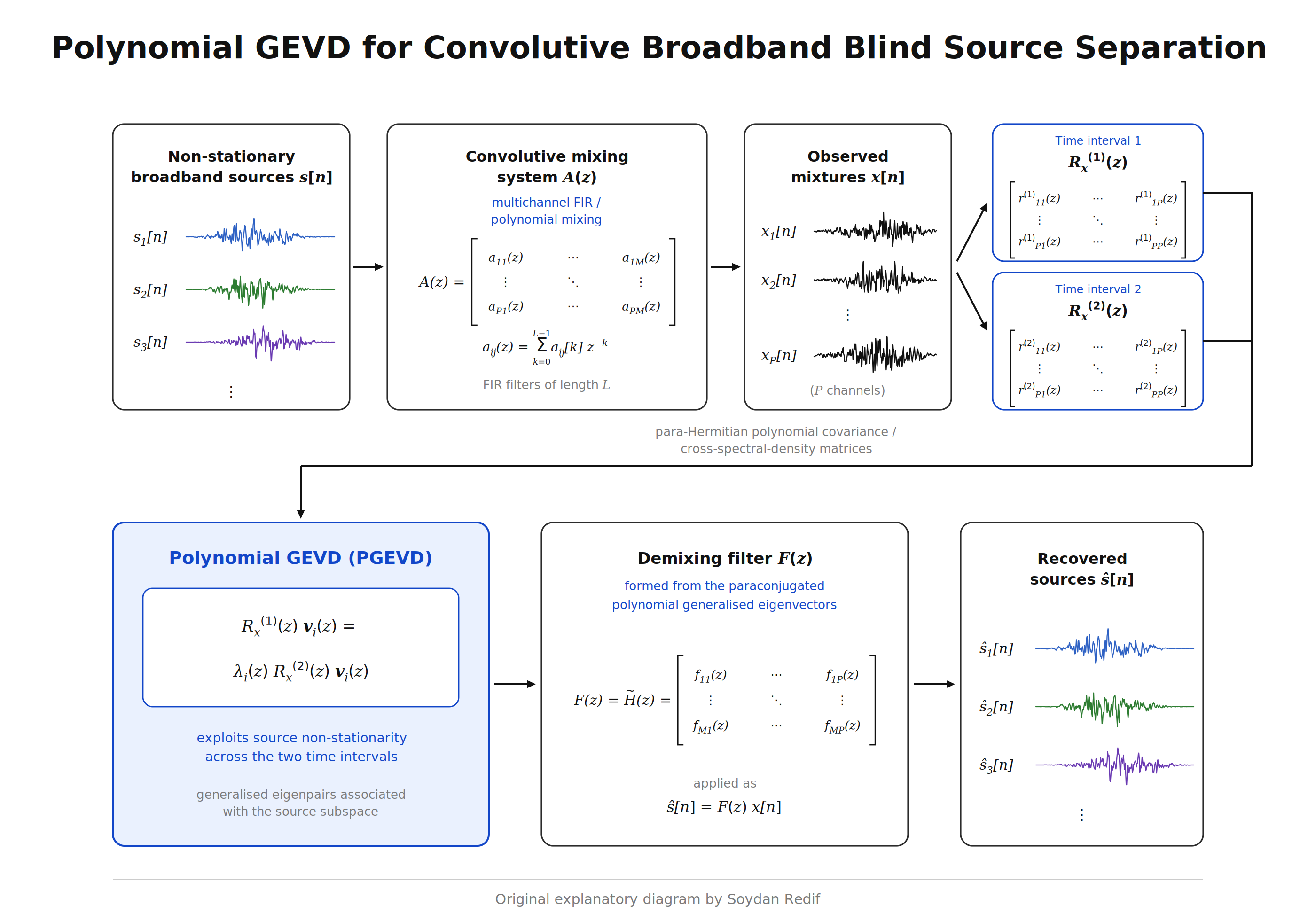
Let the broadband source vector be represented by S(z), the observed sensor signals by X(z), and the unknown convolutive mixing system by the polynomial matrix A(z). The mixing model can be written conceptually as
Each entry of A(z) represents a source-to-sensor transfer function. In the FIR case these entries are finite-order polynomials in the delay variable. The aim of broadband BSS is to determine a demixing polynomial matrix F(z) such that applying F(z) to the observations produces estimates of the original sources, subject to the usual scaling, filtering and permutation ambiguities of blind separation.
A useful source of information is temporal non-stationarity. Suppose the convolutive mixing system remains essentially unchanged while the second-order statistics of the sources vary between two time intervals. From the observed mixtures, two para-Hermitian polynomial cross-spectral-density matrices can then be estimated: Rx(1)(z) and Rx(2)(z).
The two matrices contain the same underlying mixing structure but reflect different source powers or second-order source statistics. This is the broadband analogue of the covariance-matrix pair used by narrowband GEVD-based source-separation methods. The change in source statistics provides information that can distinguish source components even though the unknown mixing system itself remains fixed.
The polynomial GEVD seeks polynomial generalised eigenpairs that, in conceptual form, satisfy
Unlike an ordinary GEVD, the matrices and eigenvectors are functions of the delay variable. Polynomial eigenvalue decomposition (PEVD) provides the broadband matrix-decomposition machinery needed to construct such a generalisation. The resulting generalised eigenvectors can be arranged to obtain a polynomial demixing system whose rows act as broadband filters on the observed sensor signals.
This formulation is important because it avoids reducing the broadband problem to a collection of unrelated narrowband frequency bins. Instead, the convolutional structure is represented directly in the polynomial domain. Para-Hermitian covariance or cross-spectral-density matrices, paraunitary transformations and polynomial eigenvalue decompositions therefore become central objects in the broadband formulation.
In 2017 I proposed an extension of the GEVD to polynomial matrices and applied it explicitly to convolutive blind signal separation of non-stationary broadband sources. The method used two related para-Hermitian polynomial matrices corresponding to different signal time intervals. This established a direct polynomial-matrix generalisation of GEVD-based narrowband BSS.
Subsequent work with Jennifer Pestana and Ian K. Proudler analysed the conditions under which this broadband GEVD-based separation approach can recover the sources. More broadly, polynomial matrix decompositions and PEVD provide a framework for broadband subspace processing, strong decorrelation, beamforming and other multichannel problems in which ordinary narrowband matrix decompositions are insufficient.